RPI30 parallel interface
Brand: Renishaw | Category: Nanotechnology
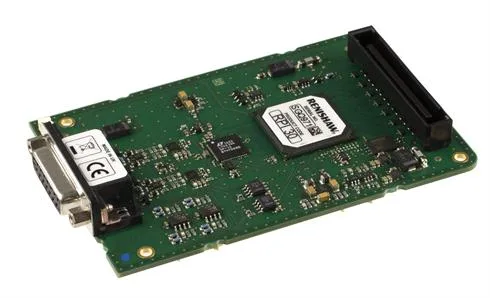
The RPI30 accepts differential analogue 1 Vpp sine and cosine signals, interpolates by 4096 and provides an output in parallel format with up to 36 bits of position data. Used with a double pass plane mirror interferometer system, whose sinusoid fundamental period is nominally 158 nm, this yields a least significant bit of 38.6 picometres at velocities up to 2 m/s. Active lissajous correction can be enabled to compensate for DC offset and AC mismatch coming from the laser encoder, improving the sub divisional error to ±0.1 nm at low velocities. Two axis position and status are carried over an LVTTL (3.0 V) compatible bus, and a diagnostics connection allows remote download and analysis.
Selected manufacturer specifications
| Parameter | Value |
|---|---|
| Analogue input | Differential 1 Vpp sine/cosine |
| Interpolation factor | 4,096 |
| Position output | 36-bit parallel word |
| Parallel bus voltage | 3.0 V, 3.3 V tolerant |
| Maximum bus output rate | 5 MHz |
Selected Renishaw manufacturer data. Confirm the exact hardware revision and configured optics, controller and software. Example spectra and sample experiments are not universal instrument specifications. Checked 2026-09-29.
Confirm your configuration
Share the details you know so we can prepare a comparable, itemised offer.
- Material/sample geometry and required measurement range or uncertainty
- Compatible sensors, fixtures, controller and environmental conditions
- Reference materials, calibration, software and installation scope
Get a Quote
Request an itemised quotation covering the proposed configuration, availability, lead time and agreed supply and support scope.
Useful details to share
- Materials, sample dimensions and process or measurement goal
- Required performance and existing instrument interfaces
Share what you know. You can start with your name and a phone number or email; final specifications can follow.
Not sure which configuration you need? Help me choose
Contact Vvon Technologies Limited about Renishaw equipment requirements in Bangladesh.
Phone: +8801805987890 | Email: info@vvon.com.bd
More from Metrology & Position Measurement
- RSU10 USB interface
The RSU10 accepts a 1 Vpp sine and cosine signal from an RLE system, interpolates by 16,384 and delivers a position reading through a USB port. That interpolation gives signal resolution down to 9.64 picometres at a velocity of 1 m/s. Measurement data works with Renishaw's established LaserXL and QuickViewXL calibration software, which suits users who need to view and analyse real time dynamic measurement data. A software development kit with a maximum update rate of 20 Hz is supplied with each unit, and a TPin trigger input lets data capture begin on receipt of an externally generated signal.
- RLU compact laser unit with fibre optic delivery (RLU10 / RLU20)
Renishaw's RLU laser units bring the performance of a displacement interferometer together with the installation ease normally associated with tape and glass scale encoders. Supplied in single or dual axis form, an RLU contains a class 2 helium neon (HeNe) laser source, stabilisation electronics, a fibre optic launch and axis position feedback electronics, and it is combined with one or two RLD detector heads to make up an RLE system. The RLU10 holds laser frequency stability within ±50 ppb over any one hour period, which suits the majority of in air applications, while the RLU20 holds ±2 ppb over the same period for the majority of vacuum applications. Both units support velocities up to 2 m/s and a vacuum wavelength stability of ±0.1 ppm over three years.
- XC-80 compensator and sensors
Air temperature, air pressure and relative humidity all shift the wavelength of light from a laser interferometer, and the XC-80 compensator corrects for that automatically. Its intelligent sensors process readings at source, and the compensator uses them to convert the nominal laser wavelength into a true value against which the interferometer read-out is adjusted, with no user intervention needed. Updates can happen automatically every seven seconds, shown by LED status lights, and the integral USB connection supplies power so no separate PC interface or power supply is required. Up to three material temperature sensors can be attached so linear measurements are normalised to a standard material temperature of 20 °C, and the standard 5 m sensor cables are detachable and can be screwed together for longer machines.