LSR L33
Brand: Linseis | Category: Nanotechnology
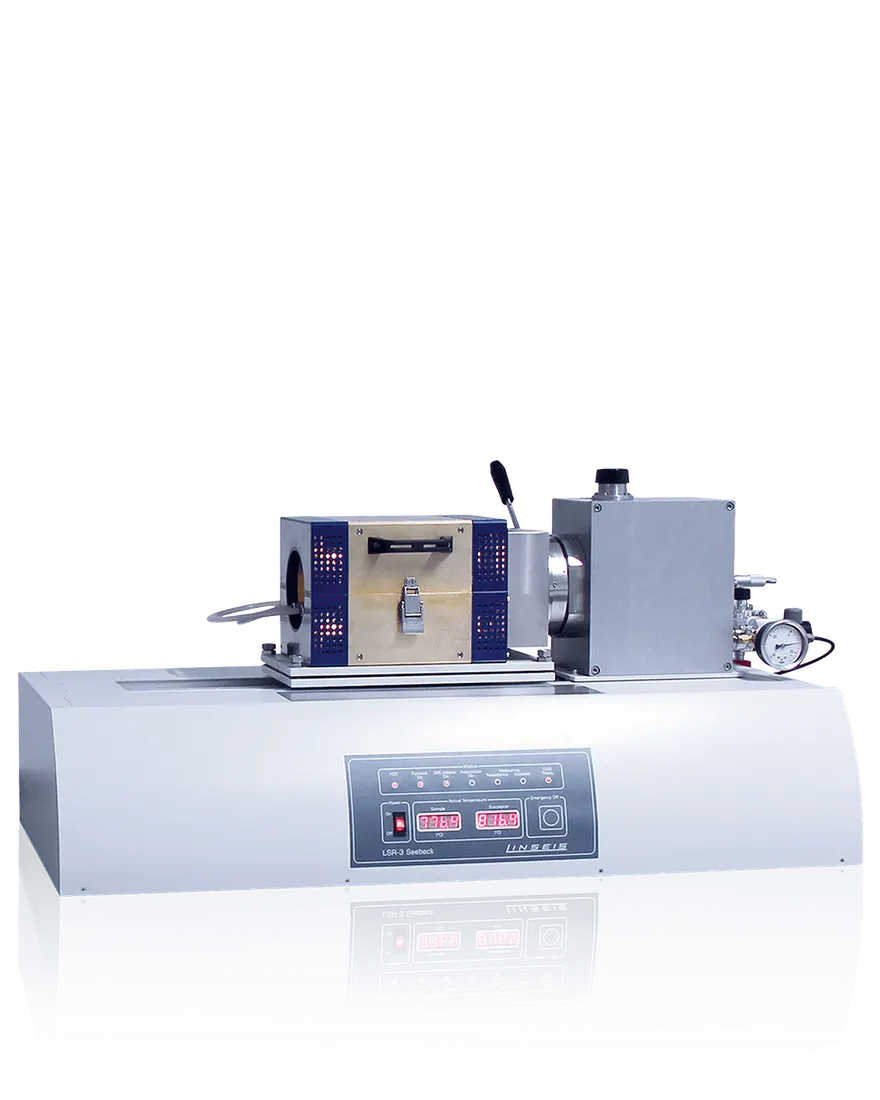
The LSR L33, formerly the LSR-3, measures the Seebeck coefficient and the electrical conductivity of solids and thin films. The sample is clamped vertically between two electrodes and interchangeable furnaces cover -100 C to 1500 C. It is used to characterise thermoelectric materials.
Technical Specifications
| Parameter | Value |
|---|---|
| Temperature range | infrared furnace RT up to 800 C/1100 C, resistance furnace RT up to 1500 C, low temperature furnace -100 C to 500 C |
| Measurement method | Seebeck coefficient static DC method / slope method, electrical resistance four-point measurement |
| Measuring range Seebeck coefficient | 1 uV/K to 5000 uV/K (static direct current method), accuracy +/-7 % / repeatability +/-3.5 % |
| Sample size (cylinder or rectangle) | 2 to 5 mm base area and max. 23 mm long |
| Sample size round (disc shape) | 10, 12.7, 25.4 mm |
| Atmosphere | inert, reducing, oxidising, vacuum |
Get a Quote
Request an itemised quotation covering the proposed configuration, availability, lead time and agreed supply and support scope.
Useful details to share
- Materials, sample dimensions and process or measurement goal
- Required performance and existing instrument interfaces
Share what you know. You can start with your name and a phone number or email; final specifications can follow.
Not sure which configuration you need? Help me choose
Contact Vvon Technologies Limited about Linseis equipment requirements in Bangladesh.
Phone: +8801805987890 | Email: info@vvon.com.bd
More from Thermal Analysis & Thermophysical Measurement
- LSR L31
The LSR L31, formerly the LSR-1, characterises thermoelectric materials as bulk samples and thin films. It measures the Seebeck coefficient and the specific electrical resistance, with a cryo option down to -160 C. The sample sits on an integrated PCB board with two heaters.
- LZT L32
The LZT L32, also published as the LZT-Meter, combines an LSR and an LFA in one instrument, so thermal conductivity, electrical resistance and the Seebeck coefficient are measured on the same sample. These values give the thermoelectric figure of merit ZT. Interchangeable furnaces cover -100 C to 1100 C.
- HCS L36
The HCS L36 is a Hall effect measuring system. It determines charge carrier mobility, specific resistance, charge carrier concentration and the Hall constant of a sample. Plug-and-play sample holders take pieces up to 12.5 x 12.5 mm2 for electrical characterisation of semiconductors.