witec360 access Entry-level Raman Microscope
Brand: Oxford Instruments | Category: Nanotechnology
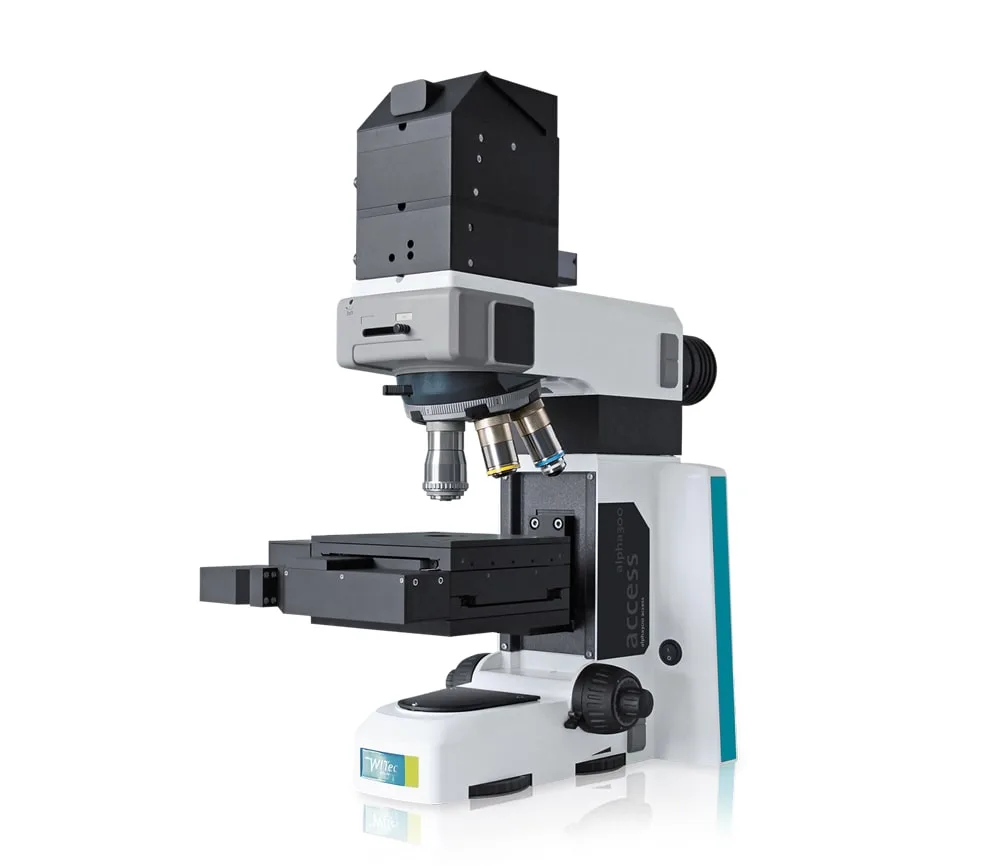
A micro-Raman microscope for single spot analysis and mapping, engineered by Oxford Instruments for budget conscious customers who still hold high demands on instrument performance. It is built to be upgraded, so a laboratory can start at entry level and extend the system later.
Selected manufacturer specifications
| Parameter | Value |
|---|---|
| Standard stage | Manual, for single-point acquisition |
| Optional stage | Motorised stage for Raman mapping |
| Observation | LED Köhler illumination and video sample view |
| Software | Integrated acquisition and evaluation suite |
Selected manufacturer data for the named configuration. Optical, detector and sample-environment options are ordered separately unless included in the quotation. Measurement results depend on the sample, selected components and operating conditions. Checked 2026-09-29.
Confirm your configuration
Share the details you know so we can prepare a comparable, itemised offer.
- Sample type, measurement method and required spectral/time range
- Source/laser, detector, resolution, sample holder and optical interfaces
- Software, laser safety/site requirements, calibration and application training
Get a Quote
Request an itemised quotation covering the proposed configuration, availability, lead time and agreed supply and support scope.
Useful details to share
- Materials, sample dimensions and process or measurement goal
- Required performance and existing instrument interfaces
Share what you know. You can start with your name and a phone number or email; final specifications can follow.
Not sure which configuration you need? Help me choose
Contact Vvon Technologies Limited about Oxford Instruments equipment requirements in Bangladesh.
Phone: +8801805987890 | Email: info@vvon.com.bd
More from Raman Spectroscopy
- witec360 Semiconductor Edition
A high end confocal Raman and photoluminescence microscope configured specifically for chemical imaging of semiconducting materials. Wafers up to 12 inch, that is 300 mm, are handled on a 300 by 350 mm scanning stage, and peak shifts below 0.01 cm-1 can be detected. Vibration damping, TrueSurface active focus stabilisation and fully automated microscope control are included, and various laser wavelengths are available.
- witec360 Raman Imaging Microscope
Oxford Instruments publish the witec360 as the new benchmark for Raman imaging and correlative microscopy, aimed at academic and industrial researchers who need comprehensive analysis at the nanoscale. The core system is broadband from 350 to 1100 nm, with options extending from 266 nm in the UV to 1064 nm in the NIR, and spectral resolution reaches 0.1 cm-1 at 633 nm excitation. Lateral resolution is below 300 nm and depth resolution below 950 nm depending on excitation wavelength, with acquisition below 1 ms per spectrum. Spectrometers are offered at 300 mm or 600 mm focal length carrying up to six gratings, the objective turret holds up to six objectives, and sample positioning travel ranges run from 25 mm by 25 mm to 350 mm by 300 mm.
- cryoRaman Cryogenic Raman Imaging Microscope
The performance and modularity of the witec360 Raman microscopes combined with advanced cryostat and nanopositioner technology, which puts experiments down to 1.8 K in high magnetic fields within easy reach. Solenoid magnets up to 12 T are available, as are vector magnets, using low vibration closed cycle attoDRY cryostats. Excitation runs from the visible to the NIR through cryogenic compatible high numerical aperture objectives, with polarisation control on both excitation and detection, and options for time correlated single photon counting and low wavenumber Raman detection.