WiRE Intelligent Fitting background removal tool
Brand: Renishaw | Category: Nanotechnology
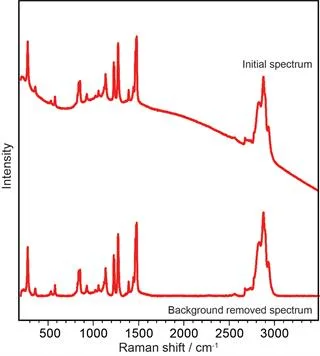
Simple or complex backgrounds can be taken off spectral data with a single button click. Intelligent Fitting is Renishaw's proprietary approach and is one of four options provided in WiRE software for removing unwanted fluorescence background; it is completely automated and works consistently and repeatably. It can be applied to a single spectrum or to a multi spectra dataset, including time series, temperature series and maps. Cleaner spectra make database identification easier, keep similar spectra consistent with each other and simplify the analysis of data from fluorescent samples.
Confirm your configuration
Share the details you know so we can prepare a comparable, itemised offer.
- Installed instrument/controller and software version to be supported
- Required analysis modules, licence term, number of users and data export
- Computer requirements, installation, training and update/support entitlement
Get a Quote
Request an itemised quotation covering the proposed configuration, availability, lead time and agreed supply and support scope.
Useful details to share
- Materials, sample dimensions and process or measurement goal
- Required performance and existing instrument interfaces
Share what you know. You can start with your name and a phone number or email; final specifications can follow.
Not sure which configuration you need? Help me choose
Contact Vvon Technologies Limited about Renishaw equipment requirements in Bangladesh.
Phone: +8801805987890 | Email: info@vvon.com.bd
More from Instrument Software
- WiRE Particle Analysis module
Particle Analysis finds particles on microscope images, reports morphology parameters such as size and aspect ratio, and then guides the inVia Raman microscope to identify them chemically. Instead of processing every particle in a Raman image, you contrast, size and separate individual particles, generate a list that can be sorted and filtered, and select only those worth full chemical analysis; the approach is called morphologically directed Raman spectroscopy (MDRS). A six step automated workflow takes the user from image generation through to reporting results, with detailed colour thumbnails for viewing individual particles. Applications range from filtered environmental particles such as microplastics to deposited pharmaceutical sprays and inhalers, forensic trace materials, graphene and other 2D materials, and biological work such as cytology.
- WiRE Empty Modelling method
Empty Modelling is Renishaw's patented chemometric method for extracting chemical information from Raman data, and it is aimed at samples where you do not know which chemicals or species are present. It determines the spectra of the key components and generates high quality images of how those components are distributed. Because Renishaw developed it specifically for Raman data, the resulting images and spectra are easier to interpret than those from the more abstract principle component analysis (PCA). In short it tells you what is present, where it is and how big it is.
- WiRE Spectrum Search tool
Spectrum Search identifies unknown Raman spectra quickly and accurately, using custom search algorithms that cope with pure chemical components as well as mixtures. It can draw on Renishaw's application specific Raman spectral libraries or on other commercially available libraries, and it scans multiple databases simultaneously to return the best match for an unknown spectrum. In interactive mode you pick the spectra of interest and run library scans yourself; in automatic mode you define the maximum number of components in the mixture, and the software matches the first component then searches automatically for the best matches to the residual spectra. Custom libraries, masked spectral regions and Intelligent Fitting background removal are also part of the tool.