Suppository Hardness Tester SBT 2
Brand: Erweka | Category: Scientific & Laboratory Equipment
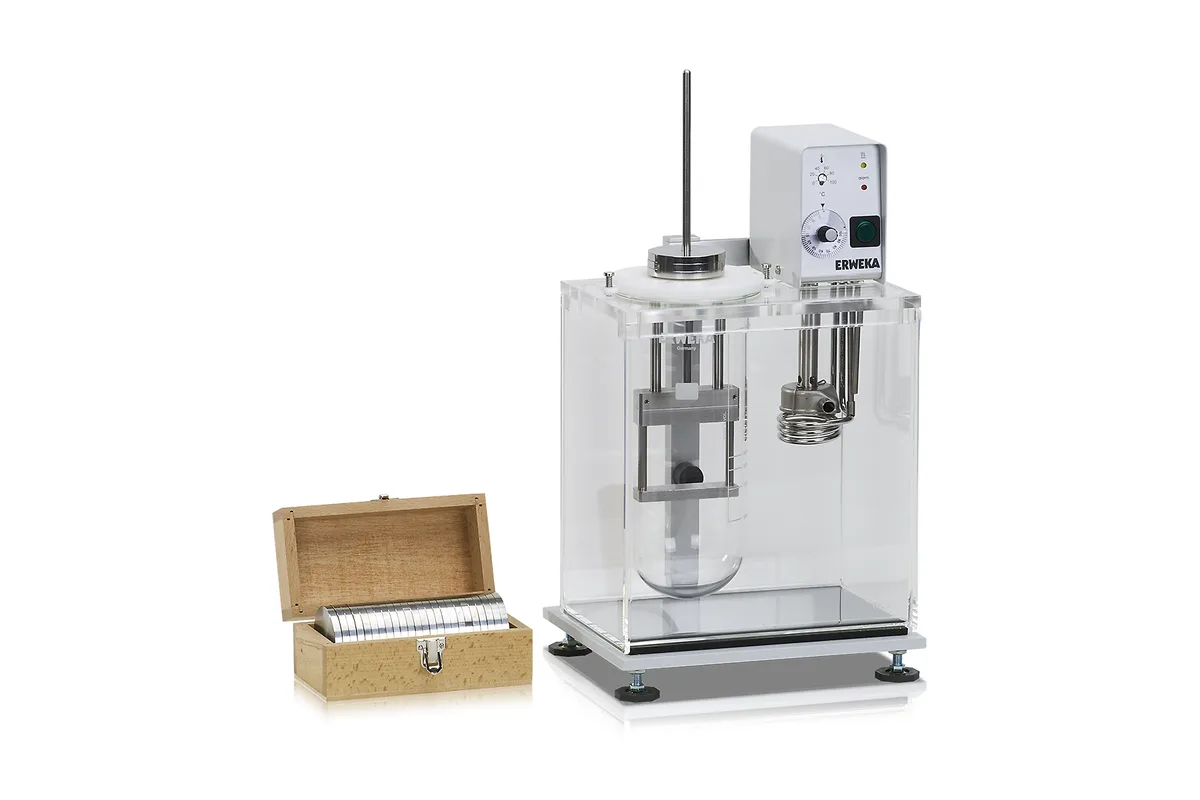
The SBT 2 suppository hardness tester is built around an electrically heated chamber with an integrated sample holder and a set of interchangeable plastic inserts that hold suppositories of different sizes. Once the desired temperature is reached, hardness is tested using weights supplied as standard, which are placed on the device one after another until the suppository collapses under the load. Results are expressed as the total weight required to collapse the suppository.
Technical Specifications
| Parameter | Value |
|---|---|
| Weight | 5 kg |
| Dimensions (H x W x D) | 570 x 290 x 230 mm |
| Voltage | 220 - 240 V / 50-60 Hz; 115 V / 50-60 Hz; 1600 W |
| Fuses | 15 A + 2 A (240 V) / 2 A (115 V) |
| Protection class | I/EN 61140 |
| Protection type | IP 21/IEC 529 |
| Water bath material | Acrylic glass |
| Ambient temperature during operation | + 10 °C up to +30 °C (Ambient temperature at least 5°C lower than test temperature) |
| Storage and transport temperature | +5 °C up to +40 °C |
| Relative air humidity | 25 to 80 % non-condensing |
Published manufacturer data for the listed model or variants. Confirm the exact configuration, accessories and test conditions in the quotation. Checked 2026-09-29.
Confirm your configuration
Share the details you know so we can prepare a comparable, itemised offer.
- Test method, dosage form and required throughput
- Exact model configuration, measuring range and method-specific accessories
- Data handling, qualification/calibration documents and operator training
Get a Quote
Request an itemised quotation covering the proposed configuration, availability, lead time and agreed supply and support scope.
Useful details to share
- Intended application, process or teaching activity
- Required capability and equipment it must work with
Share what you know. You can start with your name and a phone number or email; final specifications can follow.
Not sure which configuration you need? Help me choose
Contact Vvon Technologies Limited about Erweka equipment requirements in Bangladesh.
Phone: +8801805987890 | Email: info@vvon.com.bd
Back to Scientific & Laboratory Equipment
More from Laboratory Instruments
- Melting Point Tester SSP
The SSP measures the melting point of suppository samples. It is made up of a graduated tube with an integrated glass test chamber, and the sample under test sits in a spiral shaped glass test basket inside that chamber. A water jacket surrounds the chamber, and the water within it can be heated with the optional EST 2 circulation heater.
- Suppository Penetration Tester PM 30
The PM 30 measures the softening time of suppositories, which must disintegrate, dissolve or melt at body temperature for their active ingredients to be released. Erweka offer a version for EP method A and for method B: the PM 30 penetration tester is Apparatus A according to EP and the PM 3 is Apparatus B. Both were developed to give reproducible measurements of softening time at specified temperatures, and the design of the test device makes visual observation of melting characteristics straightforward. The unit consists of three test stations.
- Suppository Disintegration Tester ST 35
The ST 35 has three turnable test stations, each sitting in a four litre glass vessel with an optional magnetic stirrer, and a thermostatically heated water bath that Erweka describe as leak proof and double secured. Test stations turn automatically through 180 degrees at adjustable intervals. An integrated high performance flow through heating system holds accuracy to ± 0.2 °C and an internal temperature sensor drives the temperature display. Test time and set bath temperature are entered on membrane keys, with current test time and water temperature shown on clearly visible red LEDs, and an alarm can be selected to sound once the set test time has elapsed. The width of the unit lets the test stations be separated for easier cleaning.