NovaFLIM
Brand: PicoQuant | Category: Nanotechnology
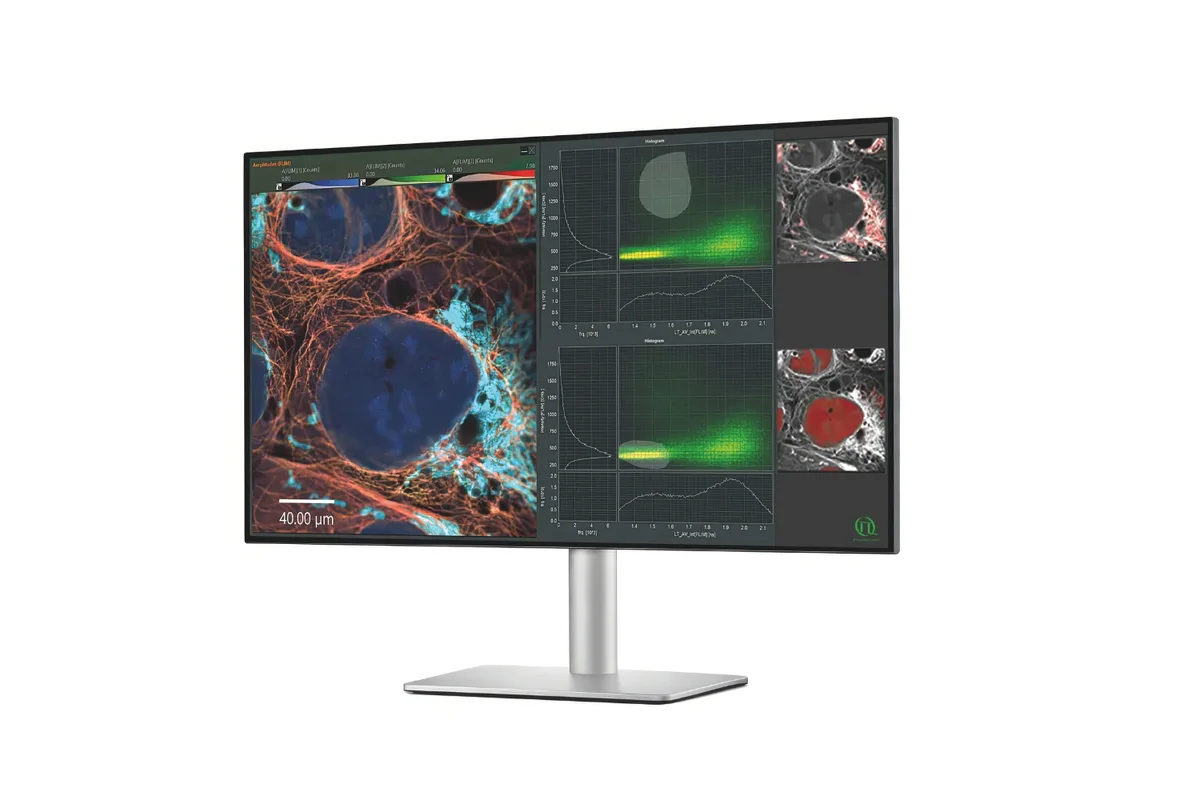
NovaFLIM is PicoQuant's analysis software for fluorescence lifetime imaging, with GPU acceleration applied to FLIM, FLIM-FRET and anisotropy data. Analysis modes span fast lifetime determination, multi-exponential decay fitting, phasor plots and pattern matching for species separation and multiplexing, alongside FLIM-FRET analysis and anisotropy imaging. Batch analysis handles z-stacks, time-lapse series and stitched images, and ROI selection can be made reproducible using histograms of the fitted parameters. ISM-FLIM is supported in combination with PDA-23 SPAD detection.
Published software requirements
| Parameter | Value |
|---|---|
| Licence type | License available for either 1, 2, or 4 years |
| Data formats | .spqr files and .ptu files acquired with Luminosa microscope. | *.ptu files acquires with MicroTime200 and LSM Upgrade kits with SymPhoTime 64 versions > 2.5 (March 2020 and onwards). |
Model specifications
Compare the named models or configurations. Confirm options and included accessories in your quotation.
| Computer requirement | Minimal | Recommended |
|---|---|---|
| Operating system | Win10 64-bit | Win10 / Win11 64-bit |
| CPU | Intel Core i3-8100 or AMD Ryzen 3 1300X | Intel Core i7-13700 or AMD Ryzen 7 5700X |
| RAM | 8 GB | 32 GB |
| GPU | AMD Radeon RX550/550 Series or Nvidia GeForce GT 1030 | AMD Radeon RX 6700 XT or Nvidia GeForce RTX 3060 |
| Screen resolution | QHD (2560 × 1440) | 4K (3840 × 2160) |
Manufacturer catalogue checked 2026-09-29.
Software requirements and licence options from the manufacturer. Confirm the current release, supported microscope/detector, data formats and licence term before ordering; hardware and acquisition systems are separate.
Confirm your configuration
Share the details you know so we can prepare a comparable, itemised offer.
- Installed instrument/controller and software version to be supported
- Required analysis modules, licence term, number of users and data export
- Computer requirements, installation, training and update/support entitlement
Get a Quote
Request an itemised quotation covering the proposed configuration, availability, lead time and agreed supply and support scope.
Useful details to share
- Materials, sample dimensions and process or measurement goal
- Required performance and existing instrument interfaces
Share what you know. You can start with your name and a phone number or email; final specifications can follow.
Not sure which configuration you need? Help me choose
Contact Vvon Technologies Limited about PicoQuant equipment requirements in Bangladesh.
Phone: +8801805987890 | Email: info@vvon.com.bd
More from Instrument Software
- NovaISM
NovaISM is image scanning microscopy and FLIM analysis software that is integrated with the Luminosa microscope and optimised for the PDA-23 SPAD array detector. Working from the summed signal of all 23 SPAD pixels, pixel reassignment alone raises resolution by roughly 30%, and combined with computational sectioning and deconvolution the software delivers up to 1.7 times higher resolution than conventional confocal imaging. Computational sectioning removes out of focus contributions to lift contrast, and it can run simultaneously with lifetime species separation. Raw time tags from all 23 PDA-23 pixels remain accessible, batch analysis covers series measurements and multi-ROI workflows, and results export as BMP, PNG, OME-TIFF and SVG.
- EasyTau 2
EasyTau 2 brings hardware control, data acquisition and analysis for PicoQuant spectrometer systems into a single time-resolved fluorescence workflow. Three operating modes are offered: a Wizard mode with guided step by step workflows, a Customized mode giving full manual control of hardware and acquisition parameters, and a Scripting mode for automated measurement routines and remote execution. Analysis covers multi-exponential decay fitting up to 5th order, lifetime distribution models including Gaussian, Lorentzian and stretched exponential, anisotropy analysis from polarisation resolved studies, global and batch fitting across multiple datasets, bootstrap error analysis with confidence intervals, and IRF corrected reconvolution fitting.
- QuCoA
QuCoA is an integrated acquisition and analysis package for PicoQuant time tagging and TCSPC electronics, aimed at experiments built around photon coincidences. It calculates g(2) antibunching correlations under continuous wave or pulsed excitation, with fitting models for single emitters with and without shelving states, pulsed excitation models and detector resolution corrections. Coincidence counting is defined through user set logical filters using AND, OR and NOT across detection channels and markers within configurable time gates. A scripting language allows custom analysis routines, and the software can be driven remotely over TCP/IP while acquiring and visualising data in real time.