iDus Spectroscopy Cameras
Brand: Oxford Instruments | Category: Nanotechnology
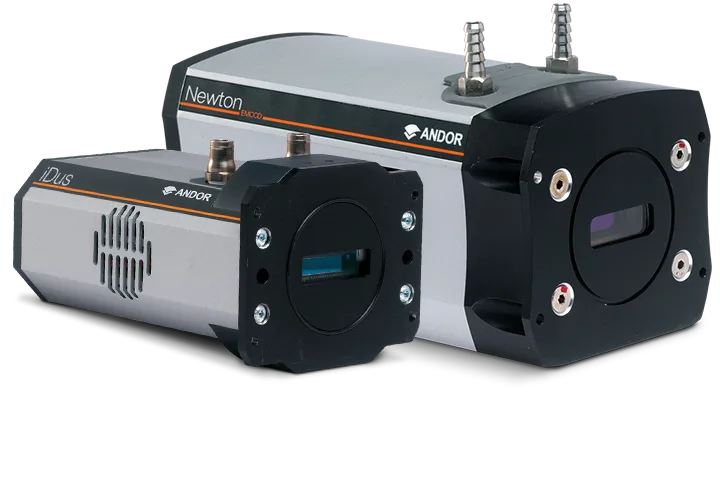
iDus is Andor's compact spectroscopy detector line for low photon flux measurement with large dynamic range, covering the ultraviolet to near infrared with CCD models and the short wave infrared with InGaAs models. The CCD variants are published in 1024 x 128, 1024 x 256 and 2000 x 256 formats with 26 or 15 µm pixels, 95% peak QE and cooling to -100 °C with UltraVac. Two InGaAs versions extend coverage, the iDus InGaAs-1.7 across 1 to 1.7 µm and the iDus InGaAs-2.2 across 1.7 to 2.2 µm, both in 512 x 1 and 1024 x 1 formats with 25 or 50 µm pixels and cooling to -90 °C. Andor lists the current CCD models as iDus 401, iDus 416 and iDus 420.
Model specifications
Compare the named models or configurations. Confirm options and included accessories in your quotation.
| Specification | iDus CCD | iDus InGaAs-1.7 | iDus InGaAs-2.2 |
|---|---|---|---|
| Matrix size (pixels) | 1024 x 128 ; 1024 x 256 ; 2000 x 256 | 512 x 1 ; 1024 x 1 | 512 x 1 ; 1024 x 1 |
| Pixel size (µm) | 26 or 15 | 25 or 50 | 25 or 50 |
| Peak QE | 95% (VIS or NIR) | 85% (@1.3µm) | 70% (@1.8µm) |
| Min. Cooling (°C) | -100 (with UltraVac™) | -90 (with UltraVac™) | -90 (with UltraVac™) |
| Min. dark current (e-/pix/s) | 0.0004 | 10,700 | 5,000,000 |
| Min. read noise (e-) | 3 | 580 | 580 |
| Max. register well depth (e-) | 1,000,000 | 170,000,000 | 170,000,000 |
| Max. spectral rate (sps) | 88 | 193 | 193 |
Manufacturer catalogue checked 2026-09-29.
Separate iDus CCD and InGaAs family columns are retained from the manufacturer comparison. Minimum noise, dark current and cooling figures depend on the exact sensor and operating conditions; they are not guaranteed simultaneously for every listed array. Confirm the model datasheet and optical configuration.
Confirm your configuration
Share the details you know so we can prepare a comparable, itemised offer.
- Sample type, measurement method and required spectral/time range
- Source/laser, detector, resolution, sample holder and optical interfaces
- Software, laser safety/site requirements, calibration and application training
Get a Quote
Request an itemised quotation covering the proposed configuration, availability, lead time and agreed supply and support scope.
Useful details to share
- Materials, sample dimensions and process or measurement goal
- Required performance and existing instrument interfaces
Share what you know. You can start with your name and a phone number or email; final specifications can follow.
Not sure which configuration you need? Help me choose
Contact Vvon Technologies Limited about Oxford Instruments equipment requirements in Bangladesh.
Phone: +8801805987890 | Email: info@vvon.com.bd
More from Photoluminescence & Time-Resolved Spectroscopy
- Newton CCD and EMCCD Cameras
Newton is Andor's spectroscopy detector platform for fast spectral rates and multi-fibre acquisition, offered as a CCD for low ultraviolet to near infrared photon flux and as an EMCCD for very low visible photon flux. The CCD version comes in 1024 x 256 and 2048 x 512 formats with 26 or 13.5 µm pixels, reaching 1,612 spectra per second, while the EMCCD version uses 1600 x 200 and 1600 x 400 formats with 16 µm pixels and reaches 1,515 spectra per second. Both cool to -100 °C with UltraVac and reach 95% peak quantum efficiency. A fast kinetics mode with microsecond resolution is available for broadband spectra.
- Intensified CCD and sCMOS Cameras
Andor's intensified camera series draws on CCD and sCMOS sensors together with gated image intensifier technology, combining rapid acquisition rates with ultra-high sensitivity down to single photon. Four platforms are offered: the iStar 320T for high resolution, nanosecond scale time-resolved spectroscopy, the 1024 x 1024 iStar 334T for time-resolved imaging, the high resolution iStar 340T for spectroscopy, and the USB 3.0 iStar sCMOS. Andor states the iStar sCMOS reaches frame rates at least 50% faster than competing CCD or interline platforms at equivalent pixel matrix size, while keeping intrinsically low noise.
- CCD, sCMOS & EMCCD Cameras for X-ray and EUV
Andor groups its high energy detection cameras into a single portfolio spanning CCD, sCMOS and EMCCD sensors for table-top laboratory and beamline experiments. The range serves extreme ultraviolet, X-ray, neutron and electron detection in material science, plasma studies, bio-sample analysis and beam or source characterisation. Three coupling approaches are covered: open front direct detection with UltraVac, fibre optic coupled indirect detection, and lens coupled indirect detection. The newest platform is the Marana-X back-illuminated sCMOS for direct X-ray detection.