DSC L63
Brand: Linseis | Category: Nanotechnology
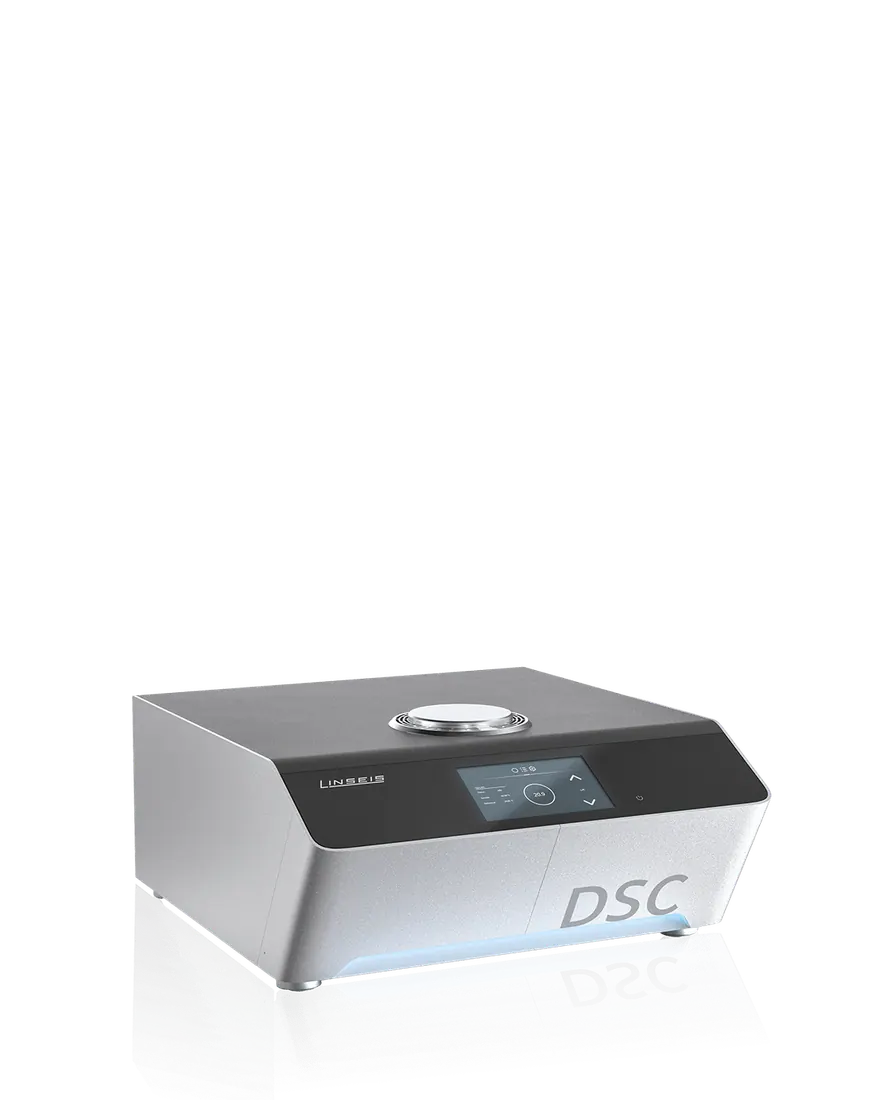
The DSC L63 is a differential scanning calorimeter that measures endothermic and exothermic transitions as a function of temperature. It records melting, crystallisation, glass transition and heat capacity data without a hardware change across its range. It is used in quality control and research.
Technical Specifications
| Parameter | Value |
|---|---|
| Temperature range | -170 C to 750 C (without hardware change) |
| Heating rates | 0.01 to 150 K/min |
| Temperature accuracy | +/-0.1 K |
| Enthalpy precision | <1 % (Indium) |
| Cooling | liquid nitrogen (LN2) or mechanical intracooler, fast cooling up to 100 K/min (to 560 C) |
| Automation | optional 90-position autosampler |
Get a Quote
Request an itemised quotation covering the proposed configuration, availability, lead time and agreed supply and support scope.
Useful details to share
- Materials, sample dimensions and process or measurement goal
- Required performance and existing instrument interfaces
Share what you know. You can start with your name and a phone number or email; final specifications can follow.
Not sure which configuration you need? Help me choose
Contact Vvon Technologies Limited about Linseis equipment requirements in Bangladesh.
Phone: +8801805987890 | Email: info@vvon.com.bd
More from Thermal Analysis & Thermophysical Measurement
- HDSC L62
The HDSC L62 is a modular high temperature differential scanning calorimeter. It determines the specific heat and enthalpy of materials such as ceramics and metals, with a stated temperature precision of 0.01 C. An optional sample robot measures up to 42 samples without operator attendance.
- TGA L87 MSB
The TGA L87 MSB is a thermogravimetric analyser built around a magnetic levitation balance, available in a metal or a glass version. It measures the change in sample mass under vacuum or in inert, oxidising and reducing gas. It is suited to highly corrosive and high pressure applications.
- Chip-DSC L66 Basic
The Chip-DSC L66 Basic, also sold as the Chip-DSC 1, is a compact differential scanning calorimeter with a replaceable chip sensor. It measures thermal transitions such as melting and crystallisation from room temperature to 450 C. It is the entry model of the Linseis Chip-DSC range.